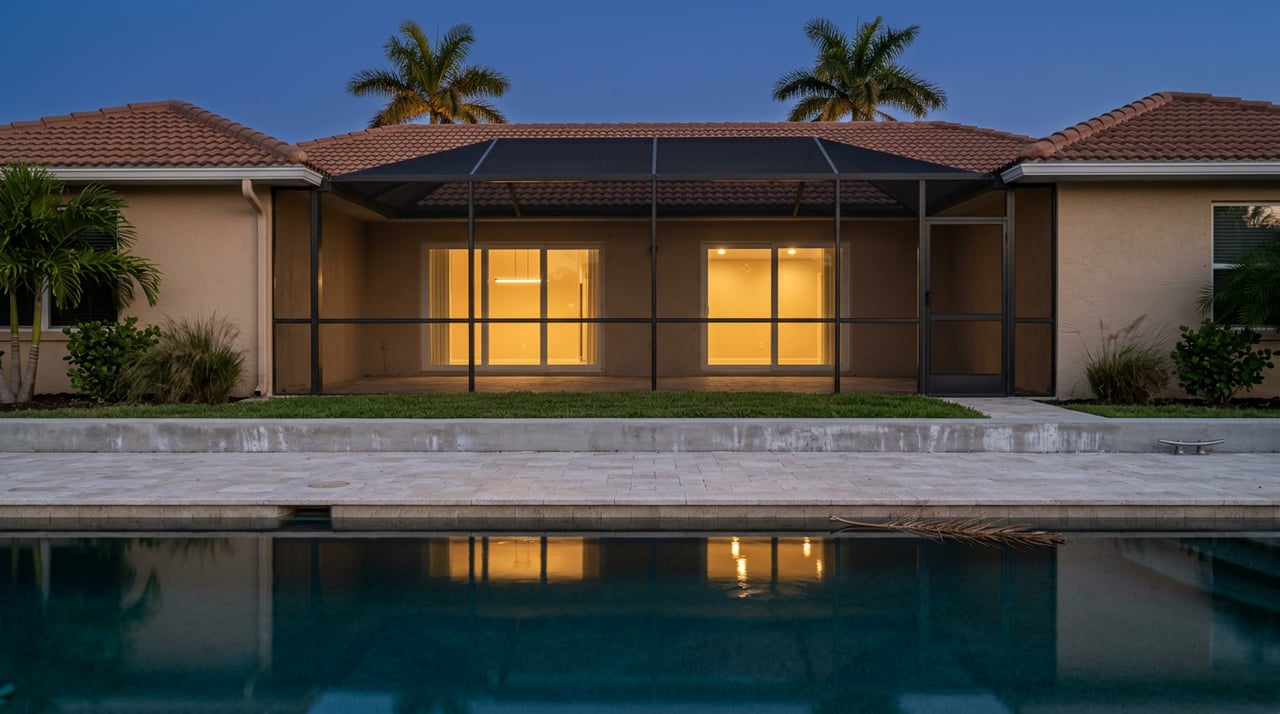
The portals will tell you Punta Gorda is a buyer's market. Homes sitting 70 to 100 days. Inventory in Charlotte County running roughly double its long-term average through 2025 and into 2026. A citywide median that has drifted down from its 2022 peak. All of that is accurate, and none of it describes the piece of Punta Gorda that most out-of-town buyers actually want.
Talk to anyone who has shopped a canal lot in Punta Gorda Isles this year and the story flips. Waterfront inventory in PGI is tightening while the rest of the city loosens, and the median list on 327 waterfront homes in the community sat at $570,000 as of March 2026. Burnt Store Isles waterfront was thinner still, 49 homes at a $650,000 median list in January 2026. Two markets, one ZIP code, one very misleading average.
The thesis of this post: in Punta Gorda, three physical attributes decide what a waterfront home is really worth, and none of them appear in the median price. Bridge clearance on your exit route, who owns your seawall, and how the house scores on a wind mitigation form.
Two Markets, One Median
The ZIP-level data makes the split visible. In June 2026, the typical home in 33950 (downtown and PGI) was valued around $368,000 with essentially flat five-year appreciation. In 33955 (the Burnt Store corridor south toward Lee County), the typical home ran about $331,000 with roughly 3.2 percent annual appreciation over five years. In 33982 (east toward Babcock Ranch), it was $360,000 with 4.0 percent annual appreciation. Three ZIPs, three different demand curves, one city name.
Blend those into a "Punta Gorda median" and you get a number that describes almost no one's actual purchase. The buyer looking at a Deep Creek pool home in 33983 and the buyer looking at a sailboat lot on Bal Harbor Boulevard are shopping different economies. Below is where the mechanics get interesting.
What Actually Sets a Canal Lot's Price
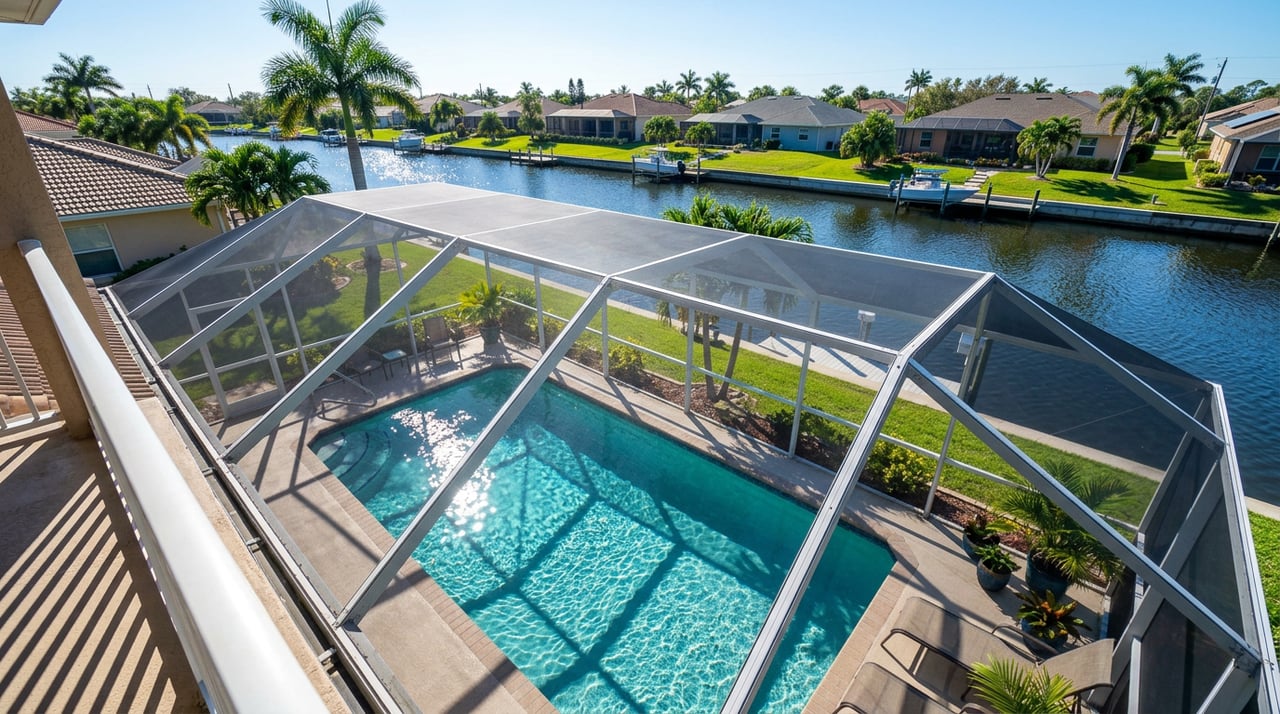
Punta Gorda Isles was platted starting in the 1960s and now includes roughly 8,700 homes. Nearly every waterfront property has a dock. The canal system exits open water at two points, Ponce de Leon Inlet on the northwest and Buckley's Pass into Alligator Creek on the south, the latter opened by the City in 2020 to shorten ride times out of the Bird Section. The City of Punta Gorda's Buckley's Pass documentation covers the original harbor-access rationale.
What the listing photos rarely make obvious is that PGI is split into two very different products by a handful of fixed bridges along West Marion Avenue.
| Attribute | Sailboat-access section | Powerboat section |
|---|---|---|
| Fixed bridges on exit route | None | One or more, 11.5 to 13.5 ft clearance |
| Boats that can pass at any tide | Sailboats, flybridge yachts, center consoles, pontoons | Most powerboats; not sailboats or tall sport-fish |
| Typical exit routes | Ponce Inlet, Buckley's Pass, or Peace River directly | Bass Inlet, Sailfish Inlet, Tarpon Inlet |
| Canal depth at MLW | Often 6 to 15 ft depending on section | Generally 6 ft+ |
| Price behavior | Consistent premium | Persistent discount, often the value play |
The premium on sailboat lots holds even though sailors are a minority of the SWFL boating population. Two identical stucco pool homes on adjacent streets can trade at meaningfully different prices because one route to Charlotte Harbor has a bridge on it and the other does not. If you own a center console with no upper station, the powerboat section is often the smarter buy at today's spreads. If you own a Beneteau, it is a non-starter regardless of how nice the kitchen is.
Within the sailboat sections, the sub-market matters too. The Original Sailboat Section north of West Marion sits closest to the Peace River with the deepest canals, roughly 8 to 15 feet. The Bird Section south of Aqui Esta Boulevard historically had longer ride times until Buckley's Pass shortened its route to under 15 minutes for many homes. Lot owners there watched their route length drop by roughly two-thirds in one construction season.
The Seawall Question Most Buyers Never Ask
Look closely at PGI and Burnt Store Isles listings and you will see the same phrase over and over: "city-maintained concrete seawall." That is not marketing filler. It is the answer to a five-figure question the buyer has not yet learned to ask.
In most Florida waterfront communities, the seawall is the owner's problem. Replacement runs into serious money on any lot with meaningful frontage, and failure is not a matter of if. In PGI and BSI, the deed-restricted structure passes that maintenance obligation to the City. Two otherwise identical canal homes, one in PGI with a city seawall and one in a private-seawall community elsewhere in Charlotte County, carry very different long-term capital exposure even when the purchase price looks similar. When you compare price per foot of frontage across SWFL waterfront markets, back this cost out or you are not actually comparing.
The Insurance Number That Reshapes the Budget
Charlotte County sits in Wind Zone 2, rated for 140 to 160 mph design winds, and it took a direct hit from Ian in 2022 and Charley before it in 2004. Both events shape 2026 premiums in ways that reward specific properties and punish others.
Average Charlotte County homeowners premiums in 2026 land roughly $3,200 to $5,200 per year on a standard site-built home, per Florida Coverage Guide's county breakdown, with waterfront exposure and older roofs pushing the top of that range higher. The statewide picture is finally softening. Broker One's 2026 county guide notes the first broad rate cuts since 2019, with State Farm, USAA, GEICO, Allstate, and Progressive filing decreases between 7 and 10 percent, and Citizens' policy count down to about 395,000 from a 1.4 million peak.
Two specific levers move a Punta Gorda quote more than almost anything else:
- Roof age and the wind mitigation form. The OIR-B1-1802 inspection is valid for five years and can trim 20 to 45 percent off a premium when it documents post-2002 code features, hip roof geometry, secondary water resistance, and opening protection.
- The post-Charley rebuild bias. A large share of Punta Gorda's older-plat homes were rebuilt or reroofed after 2004, which leaves the housing stock effectively newer-code than its year-built date suggests. Preferred carriers price that in. Two homes both listed as "1974 build" can quote at very different premiums depending on whether the roof, windows, and electrical were touched after Charley.
Then there is the hurricane deductible, which most buyers set to 2 percent by default. On a $500,000 dwelling that is $10,000 out of pocket per named storm season before the policy pays anything. Moving to a 5 percent deductible drops the premium 15 to 25 percent but raises that number to $25,000. It is a real decision, not a checkbox.
Flood is separate. In PGI's AE-zone canal frontage, flood policies routinely add $2,000 to $8,000 on top of homeowners, sometimes more on ground-floor living space with older elevation certificates. Private flood carriers frequently beat NFIP by 20 to 50 percent on the same address, so shopping matters.
How to Read a Punta Gorda Waterfront Listing
Before you fall in love with a canal home, run this checklist against the listing:
- Trace the exit route to Charlotte Harbor on a nautical chart and note every fixed bridge with its published clearance against your boat's air draft.
- Confirm whether the seawall is city-maintained or private, in writing, not from the listing description.
- Ask for the most recent OIR-B1-1802 wind mitigation report and the roof permit date.
- Pull the elevation certificate and the current FEMA flood zone, then get a flood quote from both NFIP and one private carrier before you write the offer.
- Get a homeowners quote with the specific deductible you intend to carry, not a placeholder.
Do that work on three comparable listings and the "median price" of Punta Gorda will stop being a number you care about. You will be pricing individual homes on the two or three levers that actually move value here.
FAQ
Is Punta Gorda really a buyer's market in 2026?
Citywide, the numbers say yes. Charlotte County ran roughly 114 percent above its historical inventory norm in 2025, days on market averaged 70 to 100+ through Q1 2026, and sale-to-list ratios settled around 5 percent below asking, which is roughly $18,000 of negotiating room on a $355,000 home. That leverage is real for buyers in most sub-markets. It is thinner in sailboat-access PGI and Burnt Store Isles, where waterfront inventory has been tightening and pendings surging even as the rest of the market softens.
How much does sailboat access actually add to a lot's price?
There is no single number because it varies by section, depth, and view. What is consistent is that a sailboat lot and a powerboat lot with otherwise similar attributes will not trade at the same price, and the gap has widened, not narrowed, since Buckley's Pass opened in 2020 and pulled the Bird Section into the sailboat-friendly category.
What is the biggest hidden cost buyers underestimate?
The combined homeowners plus flood plus hurricane deductible math on canal frontage, followed by the assumption that a seawall is somebody else's problem forever. Both are solvable with the right property, and both are expensive on the wrong one.
If you are trying to price a specific canal home against the right comparables, or you want a second read on a listing before you offer, the team at Bobbie Leahey works these streets weekly and can pull the wind mitigation, seawall status, and route-to-harbor detail before you drive down. Let's Get Started.