If you have lived on the Key for more than one summer, you already know August is the month the beach stops belonging to us for a few hours a day. The loggerheads have been laying since spring, and the first big wave of hatchlings is now emerging at night into a stretch of sand that, on paper, is still your backyard.
The thesis of this post is small and specific: for full-time residents, the smart adjustment in August is not to fight the closures and the lighting rules, it is to move your evening rhythm to the bay side and let the Gulf side do its job. What follows is what that actually looks like, with the current 2026 conditions at Stump Pass, the ordinance details most neighbors get half-right, and a few places to redirect a sunset walk without leaving the Key.
What August actually looks like on the sand
Nesting season in this region is officially May 1 – Oct. 31, but locals know the calendar bunches at both ends. Females come ashore heaviest in June and July. August is when the earliest nests hatch and the beach fills with staked-off patches you do not want a dog, a beach cart, or a folding chair anywhere near.
Two numbers frame the stakes. From April 15 through Oct. 31, the Sea Turtle Patrol, now in its 45th year, conducts daily surveys of Sarasota County's 35 miles of nesting beaches, from Longboat Key to Venice. And while 2025 saw record nesting activity, it also saw the highest number of sea turtle disorientations, at 717. That second figure is the one worth sitting with. Disorientation is almost always a lighting problem, and lighting is the one variable a homeowner controls.
The species mix on our sand is worth knowing by name, not just by silhouette. The Loggerhead sea turtle is the most common sea turtle seen on our beaches. It's an impressively large turtle with a recognizable heart-shaped shell. Green Sea Turtles also nest in Sarasota County, though they are less common than Loggerheads. Although less common, the Leatherback sea turtle occasionally nests in the southwest Florida area. The first documented Mote nest of the 2026 season, reported on Venice Beach, was identified as a loggerhead, which is what you should assume you are walking past on Manasota Key unless a patroller tells you otherwise.
The lighting rule most neighbors get half-right
Everyone on the Key has heard "lights out for turtles." Very few people have read what the ordinance actually asks of a beachfront or beach-adjacent home. It is not just porch lights.
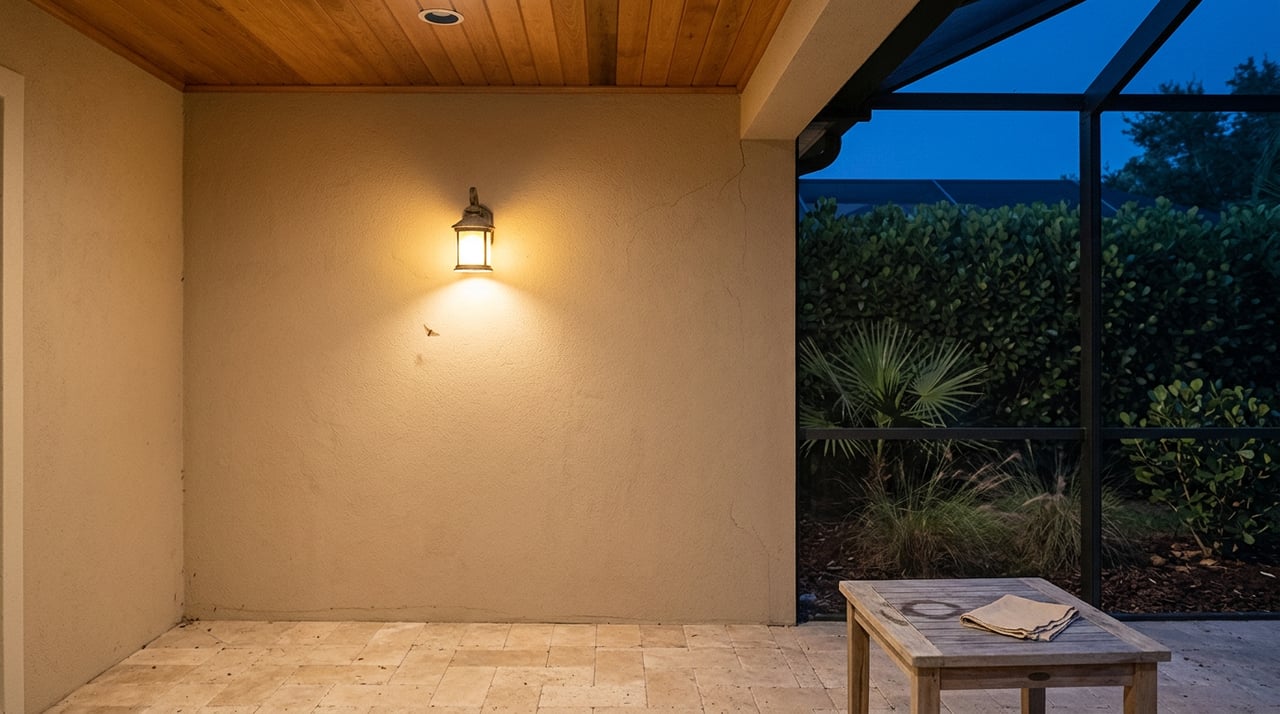
- Any exterior light visible from the sand needs to be off, shielded, or swapped to turtle-friendly amber or red.
- Interior lights facing the Gulf need drapes or blinds pulled after dark. Sliders count. Kitchen pendants count if they throw across the deck.
- Landscape uplighting on palms, pool cage accents, and driveway path lights all fall in scope if any glow reaches the beach.
The mechanism is not aesthetic. On nesting beaches, light from waterfront properties can disorient nesting female turtles and their young, who emerge at night and use dim natural light to find the sea. Hatchlings orient toward the brightest horizon they see. If that is a screened lanai instead of the Gulf, they walk inland and die.
The applicable rulebook here is not generic. Sarasota County's marine turtle protection code includes Lido, Siesta, Casey, and Manasota Keys, and the Charlotte County portion of the Key is covered by county code as well. Sarasota County residents can check the FWC's ordinance directory to confirm which specific document applies to their parcel. The practical read for a homeowner is simple: shield or turn off outdoor lights that are visible on the beach and close drapes after dark from May through October.
Stump Pass is open, but it's not the Stump Pass you remember
The park most locals default to when the tourist end of Englewood Beach gets crowded is finally back, with an asterisk. The park reopened September 19, 2025 after Hurricane Milton, but the picnic pavilion is still listed as unavailable, with temporary restrooms standing in. That means no shade structure for a birthday, no rain plan for a Saturday, and no lifeguard to backstop a mid-afternoon swim.
Two smaller changes have caught long-time users off guard. Payment moved to a QR code and credit card system, so the old cash-in-an-envelope routine is gone. Bring a phone with signal or an annual pass. And the lot is still what it always was. With roughly 50 spaces and no overflow, Stump Pass fills fast from December through April. When it is full, it is full, and there is nowhere to circle. In August that gate is less of a problem, which is one of the small mercies of summer on the Key.
The layout is also worth remembering when you plan around turtle stakes. The park covers 245 acres across three islands, including the main peninsula plus Whidden Key and Peterson Key in the bay. The Gulf-facing mile is where nests concentrate. The bay-facing paddling channels behind it are not nesting habitat in the same way.
Move the evening to the bay side
This is the part of the post that will save you the most walks that end in a U-turn. In August, the Gulf beach after dinner is a place to be careful, not a place to relax. The bay side is where the Key's summer evenings actually live.
Most people stop at the Gulf side and never see the better half. Launch a kayak and paddle the protected channels around Whidden Key and Peterson Key, where mangroves shade the water and the wind drops off. It is one of the calmer paddles in the Englewood area and a good spot to look for manatees. If you can put in by 6:30, you get the last hour of light on glass water without any concern about crossing a marked nest line.
Lemon Bay Park, Indian Mound Park, and the launch at Cedar Point Environmental Park all give you flat-water alternatives inside a ten-minute drive of the Key. The kayak trailer stays wet all season, and the sunset over the mangroves is a different picture than the one on the Gulf, not a worse one.
A short August playbook for people who already live here
Rather than a checklist, here is the way most long-time residents actually stagger the day in nesting season:
| Window | What's happening on the sand | Where locals tend to be |
|---|---|---|
| Sunrise to 9 a.m. | Patrol volunteers are surveying and marking new nests | Gulf beach for a walk before it heats up, coffee after |
| Mid-morning to mid-afternoon | Regular beach day, nests roped off with stakes and tape | Manasota Beach or Englewood Beach with an umbrella well away from any marked area |
| Late afternoon | Hatch odds start climbing, patrollers may return for checks | Home to close blinds on the Gulf side before dusk |
| After sunset in August | Peak emergence window for early nests | Bay side paddle, Dearborn Street, or indoors with lanai lights off |
The patrol you are working alongside is not the state. It is a neighbor. Coastal Wildlife Club turtle patrollers monitor, document and report on sea turtle activity for the state of Florida every morning for 16 miles from Venice Island's Caspersen Beach to Manasota Key's Stump Pass Beach State Park. If you find a nest that looks disturbed, or a hatchling wandering during the day, the number to have saved is Mote's stranding hotline. If you see a sick, injured or stranded sea turtle in coastal Southwest Florida, contact Mote Marine Laboratory's 24-hour hotline through its Stranding Investigations Program at 888-345-2335.
What is queued up on the Key for after October 31
Season closes at the end of October and two decisions that have been in motion all year will start to show themselves in the shoulder months.
The first is beach renourishment. On March 27, 2026, Charlotte County Public Works welcomed residents of Manasota Key to an informational meeting at 10 a.m., April 6, 2026 at Ann & Chuck Dever Regional Park Recreation Center Multipurpose room, 6961 San Casa Drive, to provide information regarding the Manasota Key Beach renourishment project timeline of events, impacts and potential assessment. Renourishment is a nesting-adjacent conversation because sand placement and grain size affect where turtles come ashore next year. If you own on the Key, the assessment side of that meeting is the piece to track through the fall.
The second is the Manasota Key Resort site plan, which cleared its first county hurdle in March 2026 to replace the resort damaged by Helene and Milton in 2024. A proposed resort to replace the damaged Manasota Key Resort recently took steps forward. The Manasota Key Resort was wrecked by Hurricanes Helene and Milton in 2024, according to site plans. A May rally at Englewood Beach and a follow-on Planning and Zoning discussion have kept it visible. Whatever your view of the redevelopment itself, the site is on the south end of the Key and directly adjacent to habitat the patrol walks every morning, so the design details worth watching are the ones about lighting, seawall height, and setback from the dune line.
Why any of this matters if you already live here
Nesting season is one of the small things that separates people who live on Manasota Key from people who rent for a week. Knowing which lamp to shield, which lot fills by 9 a.m., which paddle stays flat when the Gulf gets choppy, and which meeting on a Tuesday morning will shape the sand under your feet next year is the texture of the place. It is also, quietly, what a good neighbor looks like from a hatchling's point of view.
If you are thinking about what all of this means for a home you own or hope to own on the Key, from lighting compliance to dune setbacks to what renourishment does to a beachfront lot's long-term picture, that is the conversation Bobbie Leahey and the Florida Living Team have every week. Let's Get Started when you're ready to talk about it.